PS。これは私の記事を英語に翻訳したものです。私は長い間ハブレについて書いていません。すぐにごめんなさい、私はロシア語であまり書きません。私の英語がゴージャスだとは言いません。しかし残念ながら、海外に住むことは私のロシア人を悪化させ、ゆっくりと英語を発達させます。
AWS Athenaを使用してログを分析する場合、IPアドレスのソースを見つけたいことがよくあります。残念ながら、AWSAthenaはこれをすぐに提供していません。幸い、MaxMindはGeoIPテーブルのデータベースを提供しており、IPアドレスで場所を計算できます。無料版と有料版があります。
この記事では、MaxMindからS3に毎週最新のデータベースをダウンロードするAWSLambda関数を作成する方法を紹介します。このデータベースをAWSAthenaで使用して、Webログなどの分析用のSQLクエリを作成できます。
MaxMindでアカウントを作成する
MaxMindを使用して無料のGeoLite2データベースをダウンロードするには、アカウントを作成する必要があります。アカウントを作成した後、サービスでサービスキーを生成できます。それを保存。GeoLite2-City-CSV形式を使用します。
サービスキーを使用して、を使用してデータベースのダウンロードを試みることができます curl
curl -o GeoLite2-City-CSV.zip \
'https://download.maxmind.com/app/geoip_download?edition_id=GeoLite2-City-CSV&license_key={{YOUR_LICENSE_KEY}}&suffix=zip'
GeoIPデータベースをダウンロードするための最新の手順は、ここにあります。
S3でGeoIPデータベースを更新するAWSLambda関数
私自身のプロジェクトではs3://app.loshadki.data
、GeoIPデータベースをホストする予定のS3バケットを作成しました。パスに沿って2つのテーブルを配置します
s3://app.loshadki.datadata/geoip_blocks/data.csv.gz
-IPマスクのベースとそのGEO位置
s3://app.loshadki.datadata/geoip_locations/data.csv.gz
-GEOをアドレス(国、都市)にデコードします。
新しいLambda関数を作成し、私はmineという名前を付けてGeoIP-Table-Update
、を使用しますpython:3.8
。
Environment Variables :
MAXMIND_GEOIP_LICENSE
- Service Key MaxMind.
S3_BUCKET_NAME
- S3 Bucket, (app.loshadki.data
).
S3_BUCKET_PREFIX
- ,data

. Timeout 5 . Memory 256MB, CPU, CPU, . , , .

trigger. EventBridge (Cloud Watch Events), upload-geoip-to-s3-weekly
rate(7 days)
.
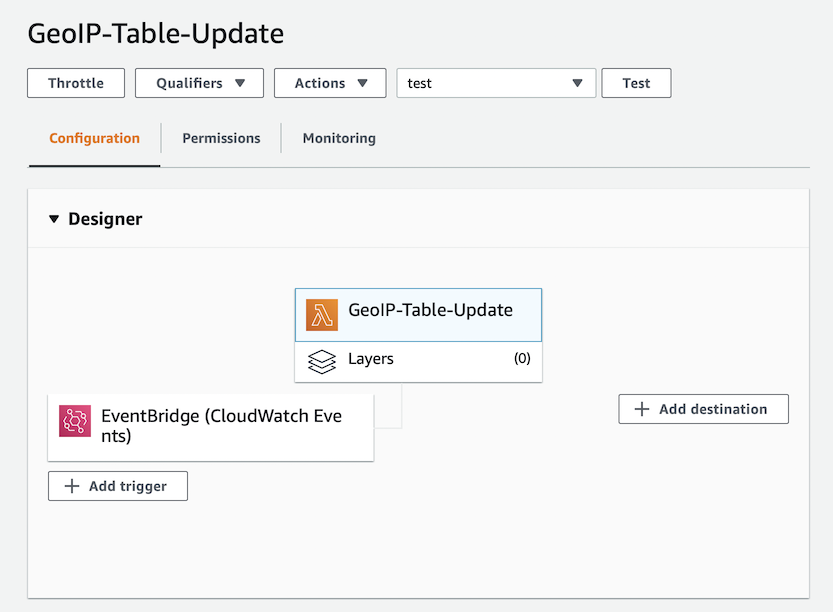
, AWS Lambda S3, , Role .
{
"Version": "2012-10-17",
"Statement": [
{
"Effect": "Allow",
"Action": "s3:PutObject",
"Resource": "arn:aws:s3:::app.loshadki.data/data/*"
}
]
}

. , Deploy . . , , S3.
import os
import os.path
import urllib.request
import shutil
import zipfile
import tempfile
import gzip
import boto3
def lambda_handler(event, context):
with tempfile.TemporaryDirectory() as tmpdirname:
zipfilename = os.path.join(tmpdirname, 'GeoLite2-City-CSV.zip')
print('step 1 - download geolite ip database')
download_geo_ip(tmpdirname, zipfilename)
print('step 2 - unzip all files')
unzip_all(tmpdirname, zipfilename)
print('step 3 - gzip files')
gzip_files(tmpdirname)
print('step 4 - upload to s3')
upload_to_s3(tmpdirname)
return
def download_geo_ip(tmpdirname, zipfilename):
geoip_url = 'https://download.maxmind.com/app/geoip_download?edition_id=GeoLite2-City-CSV&license_key={}&suffix=zip'.
format(os.getenv('MAXMIND_GEOIP_LICENSE'))
with urllib.request.urlopen(geoip_url) as response, open(zipfilename, 'wb') as output:
shutil.copyfileobj(response, output)
def unzip_all(tmpdirname, zipfilename):
# unzip all, but without the directories, to easily find the files
with zipfile.ZipFile(zipfilename, 'r') as z:
for member in z.namelist():
filename = os.path.basename(member)
# if a directory, skip
if not filename:
continue
# copy file (taken from zipfile's extract)
with z.open(member) as zobj:
with open(os.path.join(tmpdirname, filename), "wb") as targetobj:
shutil.copyfileobj(zobj, targetobj)
def gzip_files(tmpdirname):
for filename in ['GeoLite2-City-Blocks-IPv4.csv', 'GeoLite2-City-Locations-en.csv']:
file_path = os.path.join(tmpdirname, filename)
with open(file_path, 'rb') as f_in,
gzip.open(file_path + '.gz', 'wb') as f_out:
shutil.copyfileobj(f_in, f_out)
def upload_to_s3(tmpdirname):
s3_bucket_name = os.getenv('S3_BUCKET_NAME')
s3_bucket_prefix = os.getenv('S3_BUCKET_PREFIX')
s3_client = boto3.client('s3')
s3_client.upload_file(
os.path.join(tmpdirname, 'GeoLite2-City-Blocks-IPv4.csv.gz'),
s3_bucket_name,
os.path.join(s3_bucket_prefix, 'geoip_blocks/data.csv.gz')
)
s3_client.upload_file(
os.path.join(tmpdirname, 'GeoLite2-City-Locations-en.csv.gz'),
s3_bucket_name,
os.path.join(s3_bucket_prefix, 'geoip_locations/data.csv.gz')
)
AWS Athena
AWS Athena CSV , S3.
IP ( S3, CSV )
CREATE EXTERNAL TABLE IF NOT EXISTS default.geoip_blocks (
network STRING,
geoname_id INT,
registered_country_geoname_id INT,
represented_country_geoname_id INT,
is_anonymous_proxy INT,
is_satellite_provider INT,
postal_code STRING,
latitude DOUBLE,
longitude DOUBLE,
accuracy_radius INT
)
ROW FORMAT DELIMITED
FIELDS TERMINATED BY ','
LINES TERMINATED BY '\n'
LOCATION 's3://app.loshadki.data/data/geoip_blocks/'
TBLPROPERTIES ('skip.header.line.count'='1');
( S3 )
CREATE EXTERNAL TABLE IF NOT EXISTS default.geoip_locations (
geoname_id INT,
locale_code STRING,
continent_code STRING,
continent_name STRING,
country_iso_code STRING,
country_name STRING,
subdivision_1_iso_code STRING,
subdivision_1_name STRING,
subdivision_2_iso_code STRING,
subdivision_2_name STRING,
city_name STRING,
metro_code STRING,
time_zone STRING,
is_in_european_union INT
)
ROW FORMAT SERDE 'org.apache.hadoop.hive.serde2.OpenCSVSerde'
WITH SERDEPROPERTIES (
'separatorChar' = ',',
'quoteChar' = '\"',
'escapeChar' = '\\'
)
LOCATION 's3://app.loshadki.data/data/geoip_locations/'
TBLPROPERTIES ('skip.header.line.count'='1');
SQL
select *
from default.geoip_blocks t1
inner join default.geoip_locations t2 on t1.geoname_id = t2.geoname_id
limit 10
IP (CIDR lookup)
geoip_blocks
CIDR , 1.0.0.0/24
, 1.0.0.0
1.0.0.255
. Presto IP CIDR . AWS Athena ( 2) , Presto 0.217. .
IP Integer, ip_start <= ip_address <= ip_end
. IP Integer , ipv4[1]*256*256*256 + ipv4[2]*256*256 + ipv4[3]*256 + ipv4[4]
. /24
IP .
View geoip_blocks
CREATE OR REPLACE VIEW geoip_blocks_int AS
select
cast(ip[1] as BIGINT)*256*256*256 + cast(ip[2] as BIGINT)*256*256 + cast(ip[3] as BIGINT)*256 + cast(ip[4] as BIGINT) as ip_start,
(
bitwise_or(cast(ip[1] as BIGINT), bitwise_and(255, cast(power(2, greatest(8 - range, 0)) as BIGINT)-1))
)*256*256*256 +
(
bitwise_or(cast(ip[2] as BIGINT), bitwise_and(255, cast(power(2, greatest(16 - range, 0)) as BIGINT)-1))
)*256*256 +
(
bitwise_or(cast(ip[3] as BIGINT), bitwise_and(255, cast(power(2, greatest(24 - range, 0)) as BIGINT)-1))
)*256+
(
bitwise_or(cast(ip[4] as BIGINT), bitwise_and(255, cast(power(2, greatest(32 - range, 0)) as BIGINT)-1))
) as ip_end,
network,
geoname_id,
registered_country_geoname_id,
represented_country_geoname_id,
cast(is_anonymous_proxy as BOOLEAN) as is_anonymous_proxy,
cast(is_satellite_provider as BOOLEAN) as is_satellite_provider,
postal_code,
latitude,
longitude,
accuracy_radius
from
(
select
network,
geoname_id,
registered_country_geoname_id,
represented_country_geoname_id,
is_anonymous_proxy,
is_satellite_provider,
postal_code,
latitude,
longitude,
accuracy_radius,
split(network_array[1], '.') as ip,
cast(network_array[2] as BIGINT) as range
from
(
select
network,
geoname_id,
registered_country_geoname_id,
represented_country_geoname_id,
is_anonymous_proxy,
is_satellite_provider,
postal_code,
latitude,
longitude,
accuracy_radius,
split(network, '/') as network_array
from default.geoip_blocks
)
)
結果を試す
たとえば、IPアドレスの場所を見つけようとすることができます1.1.1.1
。もう一度整数に変換するだけです。

with ips as (
select
(
cast(ip_array[1] as BIGINT)*256*256*256 +
cast(ip_array[2] as BIGINT)*256*256 +
cast(ip_array[3] as BIGINT)*256 +
cast(ip_array[4] as BIGINT)
) as ip_int,
ip
from (
select
'1.1.1.1' as ip,
split('1.1.1.1', '.') as ip_array
) as source
)
select
ips.ip,
locations.continent_name,
locations.country_name,
locations.city_name,
locations.time_zone
from
ips as ips
left join geoip_blocks_int as blocks on blocks.ip_start <= ips.ip_int and ips.ip_int <= blocks.ip_end
left join geoip_locations as locations on blocks.geoname_id = locations.geoname_id
CloudFrontからのログがあり、国や都市ごとにグループ化された最も人気のあるページを表示する場合は、もう少し複雑なSQLクエリです。
with access_logs as (
select
uri,
(
cast(split(ip, '.')[1] as BIGINT)*256*256*256 +
cast(split(ip, '.')[2] as BIGINT)*256*256 +
cast(split(ip, '.')[3] as BIGINT)*256 +
cast(split(ip, '.')[4] as BIGINT)
) as ip_int
from (
select uri,
case xforwarded_for
when '-' then request_ip
else xforwarded_for
end as ip
from access_logs_yesterday
where
sc_content_type = 'text/html'
and status = 200
and method = 'GET'
and not regexp_like(url_decode(user_agent), '(bot|spider)')
)
)
select
count(*) as count,
access_logs.uri as uri,
locations.continent_name,
locations.country_name,
locations.city_name,
locations.time_zone
from
access_logs
left join geoip_blocks_int as blocks on
blocks.ip_start <= access_logs.ip_int and access_logs.ip_int <= blocks.ip_end
left join geoip_locations as locations on blocks.geoname_id = locations.geoname_id
group by 2, 3, 4, 5, 6
order by 1
次は何ですか?
列を使用するpostal_code
か、AWSQuickSightcity_name
とともにcountry_name
レポートを作成できます。また、関数が2回以上落ちた場合に、何かが壊れているかどうかを知るために、CloudWatchAlertを自分で作成しました。