ここで前の投稿を参照してください。
予測
最後に、線形回帰の最も重要なアプリケーションの1つである予測について説明します。身長、性別、生年月日を考慮して、オリンピックの水泳選手の体重を予測するモデルをトレーニングしました。
9回のオリンピック水泳チャンピオンであるマークスピッツは、1972年のオリンピックで7個の金メダルを獲得しました。彼は、1950年に生まれ、ウィキペディアのウェブサイトによると、身長183 cm、体重73kgです。モデルがその重みの観点から何を予測するかを見てみましょう。
私たちの重回帰モデルでは、これらの値を行列形式で提供する必要があります。正しい係数を適用するには、モデルが特徴を学習した順序で各パラメーターを渡す必要があります。バイアスの後、特徴ベクトルには、モデルがトレーニングされたのと同じ単位で、身長、性別、生年月日が含まれている必要があります。

β 行列には、次の各機能の係数が含まれています。

モデルの予測は、 各行の係数β と特徴xの積の合計になります。

, β xspitz.
, :

βTx — 1 × n n × 1. 1 × 1:

:
def predict(coefs, x):
''' '''
return np.matmul(coefs, x.values)
def ex_3_29():
''' '''
df = swimmer_data()
df['_'] = df[''].map({'': 1, '': 0}).astype(int)
df[' '] = df[' '].map(str_to_year)
X = df[[', ', '_', ' ']]
X.insert(0, '', 1.0)
y = df[''].apply(np.log)
beta = linear_model(X, y)
xspitz = pd.Series([1.0, 183, 1, 1950]) #
return np.exp( predict(beta, xspitz) )
84.20713139038605
84.21, 84.21 . 73 . , , .
. , , . , , . ŷ , , μ. , , y .
, , , . 95%- – , 95% . , 95%- – , 95%- .
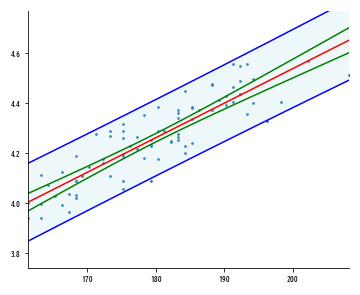
. , :

ŷp — , . t-, n - p, .. . , F-. , , , , , 95%- .
def prediction_interval(x, y, xp):
''' '''
xtx = np.matmul(x.T, np.asarray(x))
xtxi = np.linalg.inv(xtx)
xty = np.matmul(x.T, np.asarray(y))
coefs = linear_model(x, y)
fitted = np.matmul(x, coefs)
resid = y - fitted
rss = resid.dot(resid)
n = y.shape[0] #
p = x.shape[1] #
dfe = n - p
mse = rss / dfe
se_y = np.matmul(np.matmul(xp.T, xtxi), xp)
t_stat = np.sqrt(mse * (1 + se_y)) # t-
intl = stats.t.ppf(0.975, dfe) * t_stat
yp = np.matmul(coefs.T, xp)
return np.array([yp - intl, yp + intl])
t- , .
, se_y
t- t_stat
.
, , :
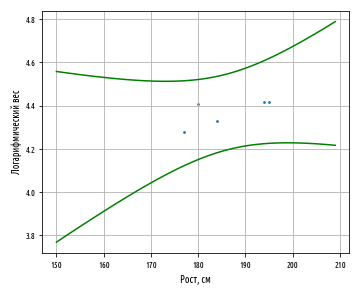
5 , 95%- . , :
def ex_3_30():
'''
'''
df = swimmer_data()
df['_'] = df[''].map({'': 1, '': 0}).astype(int)
df[' '] = df[' '].map(str_to_year)
X = df[[', ', '_', ' ']]
X.insert(0, '', 1.0)
y = df[''].apply(np.log)
xspitz = pd.Series([1.0, 183, 1, 1950]) # .
return np.exp( prediction_interval(X, y, xspitz) )
array([72.74964444, 97.46908087])
72.7 97.4 ., 73 ., 95%- . .
1950 ., 2012 . , , , . .
, . , , . , , . 1979 ., .
, 1972 . 22- 185 . 79 .
— .
, , .
R2, , . , .. , , , - .
β :
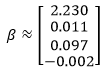
1972 . :
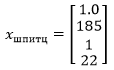
:
def ex_3_32():
'''
'''
df = swimmer_data()
df['_'] = df[''].map({'': 1, '': 0}).astype(int)
X = df[[', ', '_', '']]
X.insert(0, '', 1.0)
y = df[''].apply(np.log)
beta = linear_model(X, y)
#
xspitz = pd.Series([1.0, 185, 1, 22])
return np.exp( predict(beta, xspitz) )
78.46882772630318
78.47, .. 78.47 . , 79 .
, . , r R2 R̅2. , ρ .
, Python. , pandas numpy . β, , . , .